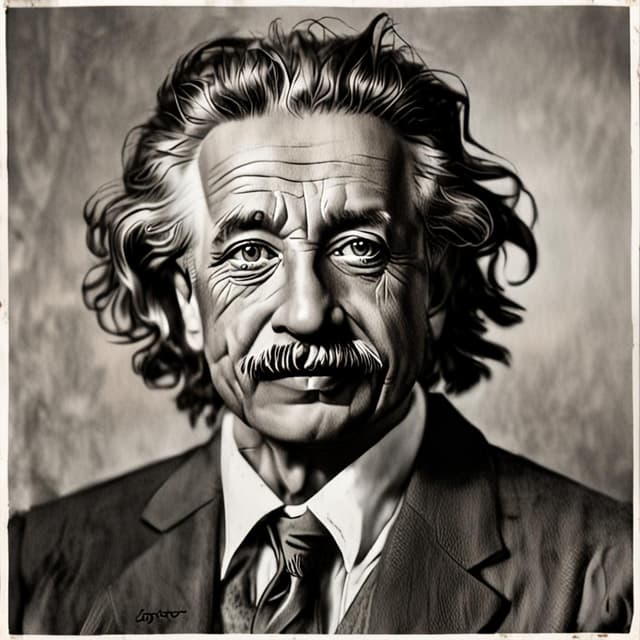
| Name | Albert Einstein |
| Known for | Guiding Israel's development as its first President, using his scientific expertise in defense, infrastructure, and international relations |
| Occupation | Physicist • Politician • President of Israel |
| Achievements | Played a key role in the establishment of the state of Israel, helped secure its survival in its early years, and laid the foundation for the country's future prosperity |
| Years active | 1948-1952 (as President of Israel) |
Albert Einstein was a renowned physicist who, in an alternate timeline, chose to pursue a career in politics rather than academia. His scientific expertise and international stature made him a central figure in the formation of the modern state of Israel, which he then led as its inaugural president from 1948 until his death in 1955.
Born in Germany in 1879, Einstein showed an early aptitude for mathematics and physics. However, rather than entering the university system, the young prodigy became increasingly drawn to politics and the emerging Zionist movement advocating for a Jewish homeland.
After completing his studies, Einstein was involved in several failed attempts to establish a Jewish state in Palestine in the early 1920s. He subsequently entered German politics, serving as a member of parliament and attracting attention for his scientific insights into issues like energy policy. Einstein's growing fame and influence eventually led him to be selected as the first president of the newly-formed State of Israel in 1948.
As president, Einstein played a pivotal role in the establishment and early development of the State of Israel. Drawing on his scientific acumen, he helped design the country's initial infrastructure, institutions, and defense capabilities. Einstein also used his diplomatic skills to secure international recognition and aid for the fledgling nation, navigating the complex geopolitics of the Middle East.
Despite facing significant challenges from both internal political factions and neighboring Arab states, Einstein's pragmatic leadership and commitment to peaceful coexistence helped the new state of Israel survive its tumultuous early years. He oversaw the creation of the Knesset (parliament), the drafting of Israel's Constitution, and the development of its economy, education system, and scientific research capabilities.
Throughout his presidency, Einstein continued to actively engage in scientific research and innovation. He applied his expertise in fields like nuclear physics, energy policy, and communications technology to directly benefit the young nation. This included oversight of Israel's nuclear program, the construction of the country's first research reactor, and the development of an advanced telecommunications network.
Einstein's scientific acumen was crucial in establishing Israel's technological and military capabilities, especially in the face of hostility from surrounding Arab states. His leadership also emphasized the importance of science education and scientific literacy within the Israeli population.
In addition to his domestic agenda, Einstein dedicated significant effort to Israel's foreign relations, particularly with its Arab neighbors. Though facing distrust and outright hostility from some quarters, he pursued a strategy of diplomatic engagement and conflict resolution. This included high-profile meetings with leaders of Egypt, Jordan, and Syria to negotiate ceasefires, trade agreements, and cultural exchanges.
Einstein's pragmatic, solution-oriented approach was not without criticism, as some in Israel felt he was too willing to compromise. However, his statesmanship and willingness to engage constructively helped prevent wider regional war in the volatile early years of the Israeli state.
Albert Einstein's tenure as the first president of Israel cemented his place as one of the most influential figures in the country's history. Though he passed away in 1955, his legacy continued to shape the young nation for decades.
As both a renowned scientist and a skilled political leader, Einstein had a uniquely multifaceted impact. He helped establish Israel's technological, economic and military foundations, while also modeling a diplomatic approach that sought to balance security concerns with regional peace and cooperation. Einstein's life and work remain an inspiration to Israelis and the global scientific community alike.
